For companies looking to efficiently manage content in multiple languages and reach international audiences, DNN (DotNetNuke) stands out as one of the most robust and flexible platforms. Beyond being a tool for creating websites, DNN acts as a powerful content management system, with specific features that facilitate multilingual management and search engine optimization—key factors for enhancing global visibility and the user experience.
One of DNN’s main advantages is its ability to automate content translation, classification, and personalization processes, making it a key component for international projects. Thanks to its modular architecture based on ASP.NET, it allows for the integration of various modules and controls that facilitate the creation of multilingual sites with rigorous control over content, URLs, and SEO tags—all essential for strong search engine rankings.
What Is a Multilingual Strategy in DNN and What Is It For?
A multilingual strategy allows you to adapt your content to different languages and markets, improving the user experience and expanding your international reach. In DNN, this approach is fully leveraged thanks to its native Content Localization system, which makes it easy to manage separate versions of content, optimize each language for SEO, and maintain a clear and consistent architecture. This helps search engines correctly index the site in each region, boosting global visibility and the accuracy of search rankings.
How to Use DNN as a Content Management System for Multilingual SEO
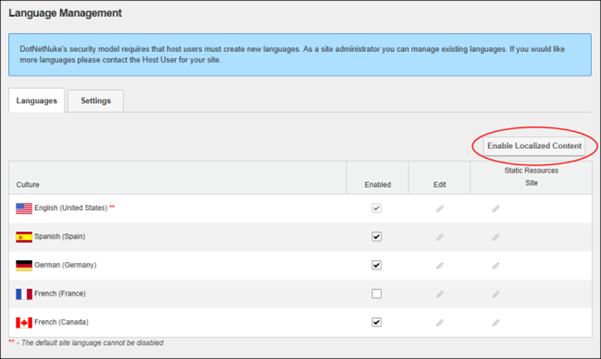
Native language version management: With its Content Localization system, DNN allows you to maintain separate versions of content for each language. This helps ensure editorial consistency, tailor messages to each market, and simplify control over what is published in each region—all from a single platform.
Robust SEO structure and architecture: DNN facilitates the creation of a clear and scalable web architecture, allowing content to be organized by language using subdirectories or well-structured hierarchical hierarchies. This helps search engines better understand the site’s structure and improves indexing in multilingual environments.
International SEO optimization using hreflang: Although DNN does not automatically insert hreflang tags, it offers the flexibility needed to integrate them through skins, templates, or external SEO modules. This allows you to indicate to Google and other search engines how the different language versions are related, avoiding duplicate content issues and strengthening international rankings.
Support for multilingual SEO-optimized sitemaps: DNN automatically generates XML sitemaps that include the different language versions of the content, making it easier for search engines to crawl the entire site structure. Although submitting these sitemaps to Google Search Console is a manual process, this feature ensures that indexing remains organized and up-to-date for each language.
Centralized and flexible content editing: DNN’s modular interface allows you to update text, manage translations, and maintain campaigns in different languages without complications. Its module-based approach makes it easy for marketing teams to keep the site up to date and aligned with the SEO needs of each market, in an agile and intuitive way.
How does DNN differ from other content management systems?
1. Open and flexible architecture:
DNN is built on ASP.NET, which allows for easy integration with other systems and custom tools. This open architecture offers greater adaptability than closed or less flexible CMS platforms, making it easier to create customized solutions.
2. Scalability and Performance:
DNN is designed for large-scale projects, supporting websites with multiple regions and languages without sacrificing speed or performance. Its architecture allows for the addition of new features, languages, and functionalities without compromising stability.
3. Ease of use and customization:
Thanks to its intuitive interface and preconfigured modules, DNN allows users with varying levels of expertise to manage content, create custom pages, and maintain full control over SEO—without needing to be programming experts.
4. Strong and active community:
DNN has a global community of developers and users who contribute plugins, modules, and support. This ensures a long lifespan, constant innovation, and access to resources that facilitate the expansion and optimization of the CMS for specific needs.
5. Robust security and advanced controls:
DNN stands out for its security-oriented architecture, inherited from the ASP.NET ecosystem, which allows for the implementation of advanced protection measures against common vulnerabilities such as SQL injections, XSS, or unauthorized access. The CMS integrates a granular system of roles and permissions that makes it easy to precisely control who can view, edit, or manage content in each language or section of the site.
Practical Use Cases for DNN in Multilingual Management and SEO
With DNN, you can manage and optimize multilingual content independently and efficiently, enhancing your international presence. These DNN features—such as multilingual management, machine translation, SEO optimization, and real-time sitemap generation—are highly adaptable and can be implemented in companies across any industry. They help improve your international presence, maintain search engine rankings, and deliver a consistent and efficient multilingual experience, enabling you to reach diverse markets with ease.
- Automatic content translation and classification: ideal for media outlets, marketing, e-commerce, and global companies that manage large volumes of content in multiple languages.
- Multilingual management and optimization for e-commerce: especially useful for online stores, marketplaces, and any business with a product catalog that needs to operate in multiple countries.
- Gradual migration to a multilingual environment without losing SEO: highly beneficial for corporations with large websites, public institutions, and companies that want to evolve their platform without affecting their visibility.
- Local SEO optimization across multiple regions: very useful for real estate agencies, retail chains, tourism, hospitality, and companies with a presence in multiple cities or countries, where local search rankings are key.
Why Use DNN to Improve Your SEO in Custom Projects?
DNN is a flexible and modular platform that facilitates the implementation of SEO best practices, such as SEO-friendly URLs, meta tags, sitemaps, and hreflang, thereby optimizing search engine indexing and improving international visibility. Its open structure and active community ensure that you can always adapt and scale your website according to market needs and SEO trends.
Additionally, as an open-source platform, DNN allows for the implementation of customized and optimized solutions, ensuring strong search engine performance and making it easier to maintain and update your project.
At Intelequia, we have a team of experts in .NET development and SEO, ready to help you maximize the benefits of DNN in your digital strategy.