Generative artificial intelligence is revolutionizing the business landscape. In the Microsoft environment, this revolution translates into two paths that, although different, can be complementary: on the one hand, Microsoft Copilot, designed to boost personal productivity on a daily basis; on the other, the AI Agents developed in Copilot Studio, aimed at automating entire business processes. Both solutions share the support and security guarantees of Microsoft 365, but their purpose and scope are not the same.
In this analysis, you will discover what differentiates one from the other, what advantages they offer, where their limits lie, and how they can fit into your AI roadmap. In addition, we review, in a practical way, how these solutions compare to other platforms on the market, so you can make decisions aligned with B2B challenges.
What can your company achieve with Microsoft Copilot?
Microsoft Copilot is an intelligent assistant that integrates with Microsoft 365 and takes productivity to another level within your usual applications: Word, Outlook, Excel, Teams, or PowerPoint. Its strength lies in its contextual intelligence, capable of extracting relevant information based on existing permissions and data in your environment.
When is it most efficient to use Copilot?
- When you need to write documents or emails and value automatic text suggestions and improvements.
- If you want to analyze or visualize data in Excel using natural language.
- To get quick summaries of meetings, long conversations, or lengthy documents.
- When preparing presentations based on your files and meetings.
- When you search for and organize relevant information within Microsoft 365 by leveraging context.
- The key? It allows knowledge workers to be much faster and more effective, but it is not designed to replace broader organizational processes.
Advantages for the company:
- Increases individual productivity: higher quality in less time.
- Reduces routine tasks and context switching between applications.
- Its adoption is straightforward: it does not require process redesign or major integrations.
Limitations to consider:
- It does not automate complex processes or those that span multiple systems.
- It always requires some human validation or supervision.
- It shines especially if you already work primarily in Microsoft 365.
What do AI Agents do?
AI Agents in Copilot Studio are more than just traditional assistants: they act as digital workers who can make decisions based on rules, plan tasks, and communicate with other systems in the company (through connectors, APIs, Power Platform, etc.). Their great advantage is that they can automate entire processes, not just specific tasks or conversations.
The AI agent market is taking off with a bang: valued at $5.9 billion in 2024, it is on track to reach $105.6 billion in 2034 thanks to explosive growth of 38.5% per year, according to Gminsights.
Where do agents add the most value in your companie?
- In onboarding and back-office management: creating accounts, sending notifications, generating tickets, or managing appointments.
- In financial tasks, such as automatically reconciling, classifying, and approving invoices.
- In operations and logistics: order fulfillment, inventory control, alerts, and automation of repetitive tasks.
- In security and compliance areas, where they can monitor, detect incidents, and execute actions (for example, using Defender or Purview).
Specific benefits:
- They improve efficiency and reduce operating costs in key business processes.
- They provide quality and consistency in execution, thanks to rule-based automation.
- They enable complex processes to be orchestrated using low-code tools and natural language.
Challenges to be managed:
- It is essential to define processes and involve both the business area and IT.
- Integrating with legacy systems or working in multi-cloud environments may require additional effort.
- Control points and metrics need to be established to audit performance and maintain alignment and compliance with business policies.
Comparison of Copilot vs. AI Agents
|
Criterion
|
Microsoft Copilot
|
AI agents (Copìlot Studio)
|
Other AI platforms (AWS, Google, IBM)
|
|
Purpose
|
Individual productivity |
Advanced process automation
|
Assistants and automation according to the architect.
|
|
Working method
|
Reactive, within M365 apps
|
Proactive: monitor and act
|
It depends on the provider and architecture.
|
|
Scope
|
Word, Excel, Outlook, Teams, PowerPoint
|
Processes across multiple systems
|
APIs and multipurpose connectivity
|
|
Target user
|
Knowledge professionals
|
Business, IT, and Operations
|
From developers to functional teams
|
|
Principal value
|
Streamline people's work
|
Reduces processing times/errors
|
Highly variable depending on the case and stack
|
|
Governance
|
Respect M365 security
|
Includes checkpoints and metrics
|
It depends on the provider.
|
|
Ease of adoption
|
Very easy
|
Average: requires process review
|
Variable depending on technology and maturity
|
|
Expected return
|
Increased productivity
|
Operational ROI in key processes
|
It depends on the fit and integration effort.
|
How to choose for your company?
Choose Copilot if:
- You are looking for quick results by improving day-to-day tasks.
- You need to streamline writing, analysis, or synthesis without touching complex processes.
- You prefer easy adoption with results in a few weeks.
Choose AI Agents if:
- Your goal is to transform entire processes, from start to finish.
- You want to reduce time and errors by integrating different departments and systems.
- You are looking for real operational efficiency and are willing to work on integration and governance.
What if you value other AI platforms?
They are an interesting option if your priority is multi-cloud flexibility or if you still depend on legacy systems. Carefully analyze the costs of connectors, security, MLOps, and the degree of compatibility with your ecosystem.
How to develop your strategy and ensure success
When implementing artificial intelligence in an organization, it is important to clearly define the first steps and move forward in an orderly manner, always focusing on collaboration between business and technology. The starting point is usually to identify the processes that will benefit most from the change: select those with high volume, where the rules are clear and the data is easily accessible. These cases become excellent candidates for experimenting with automation or intelligent assistance.
Just as important as choosing the right processes is establishing control and measurement mechanisms. It is advisable to define from the outset how and when the human factor should intervene to validate results, what metrics will be used to evaluate efficiency (such as cycle times or the degree of automation), and how much autonomy should be granted to agents.
The quality of integrations is another critical aspect. Before taking the leap, it is worth analyzing how the new assistants or agents will fit in with management systems (ERP, CRM, ITSM, ECM, among others) and validating that the quality of your data is capable of supporting automatic decisions.
Finally, don't forget to prepare your organization for change: train your teams, redefine roles if necessary, and make sure to offer support during the transition. And if you have a multi-cloud environment or maintain certain legacy systems, compare the total cost of ownership, ease of reversal, and flexibility before deciding which piece of technology to incorporate first.
Copilot is undoubtedly the best lever for immediately and seamlessly boosting individual productivity. AI agents, on the other hand, are the direct route to capturing operational efficiency and profitability through process automation, always under a firm framework of governance and metrics from day one.
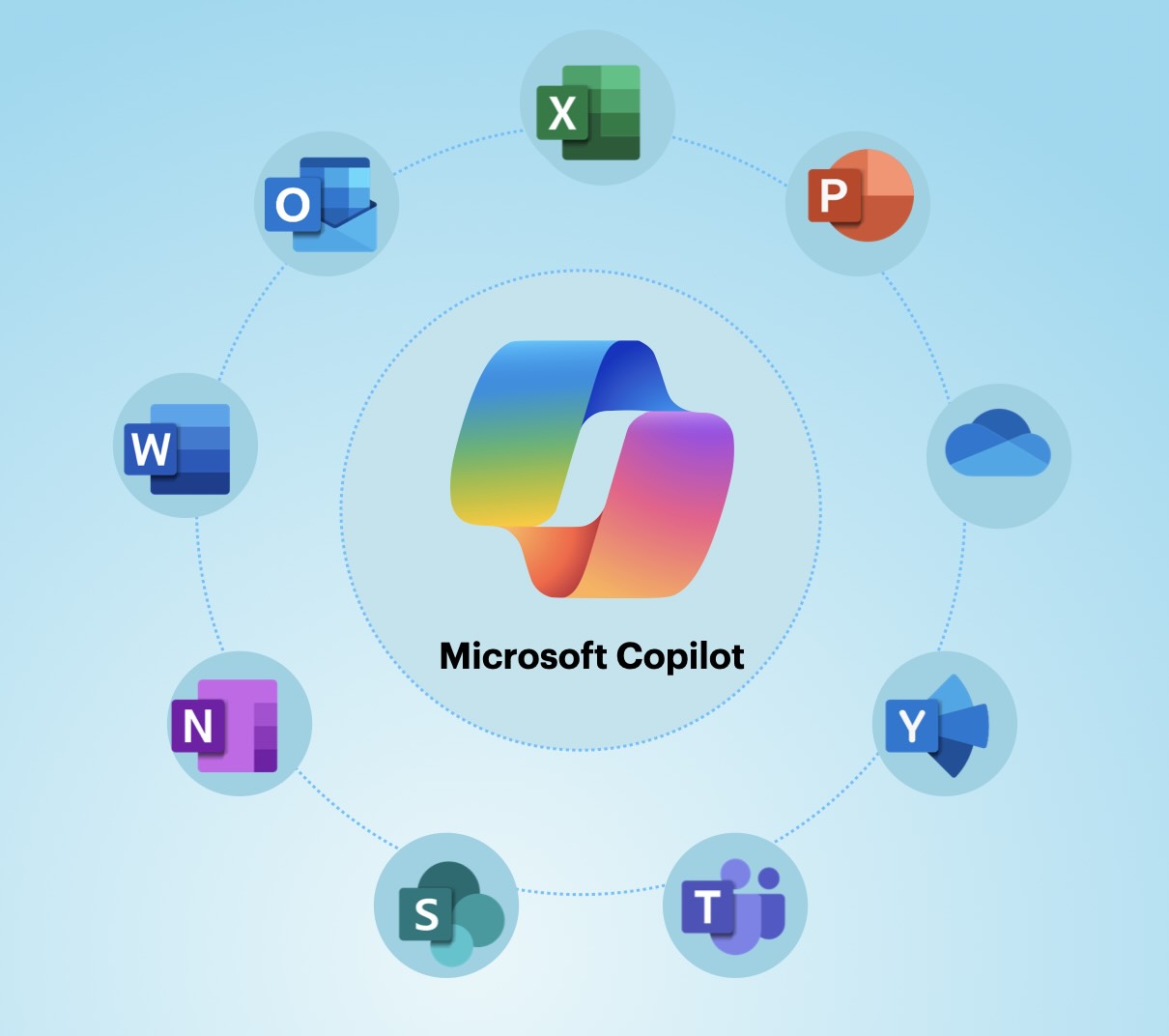 Microsoft Copilot and its integration with the Microsoft 365 environment.
The real difference lies not in choosing just one of these options, but in combining them within an ambitious, measurable, and scalable roadmap. Thus, the natural recommendation is to launch an initial pilot project with an agent on a clear process, while facilitating the use of Copilot among knowledge roles so that innovation reaches every corner of the company. Do you want to take the leap and prioritize the processes with the most potential for your business? We are here to help you.